
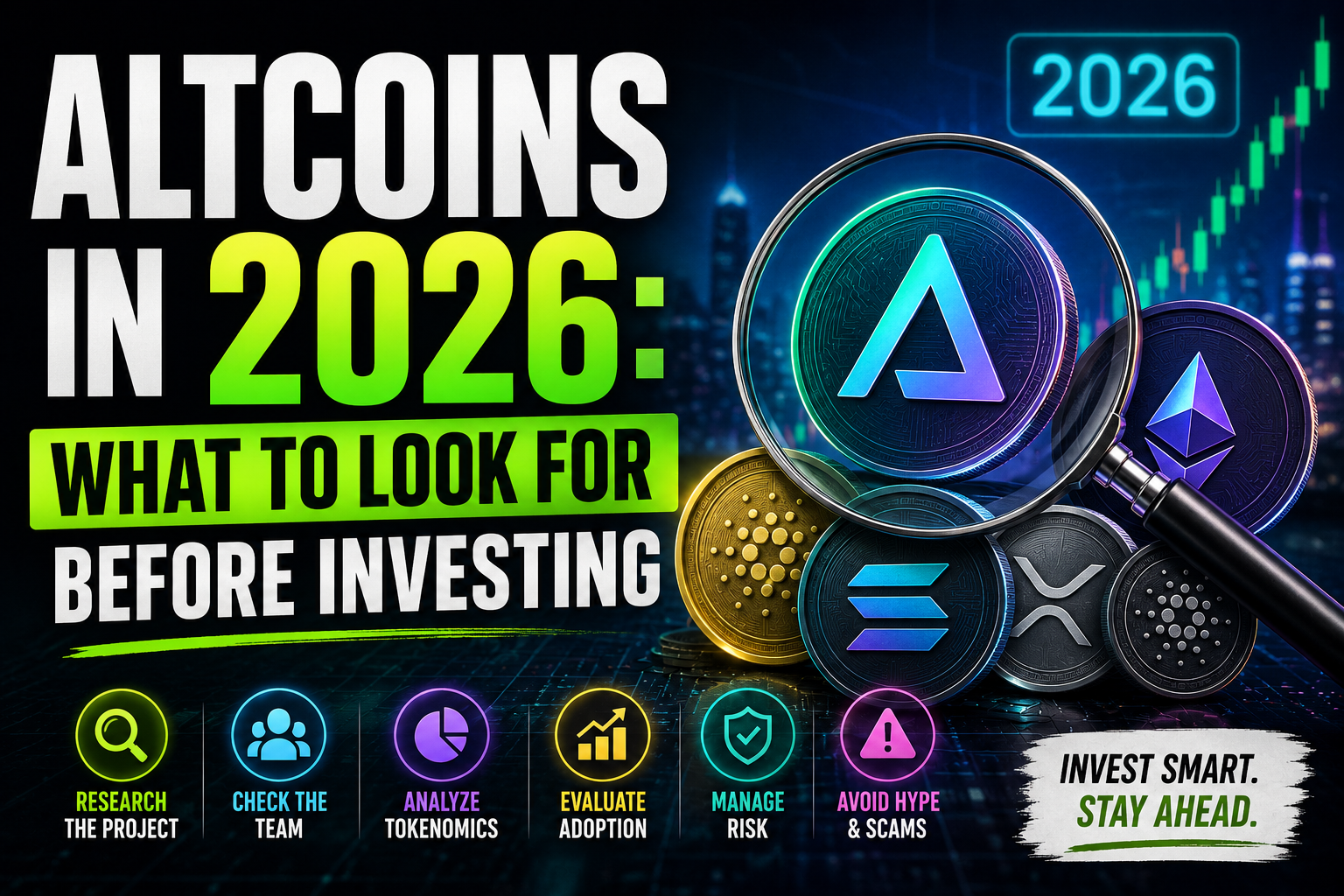
The cryptocurrency market has grown far beyond Bitcoin. Today, thousands of digital assets exist, and many of them are known as altcoins, a term generally used to describe cryptocurrencies other than Bitcoin.
For investors, altcoins can be attractive because some projects offer innovative technologies, new applications, or different approaches to blockchain. However, they can also carry significantly more risk than established cryptocurrencies.
Before investing in an altcoin in 2026, it is important to understand what you are buying, why the project exists, and what risks could affect its future.
What Are Altcoins?
The term “altcoin” originally referred to almost every cryptocurrency other than Bitcoin. Today, the category includes a wide variety of digital assets.
Some altcoins are designed to support blockchain applications, while others focus on payments, decentralized finance, gaming, artificial intelligence, data storage, or other technologies.
Ethereum is one of the most recognized examples because its blockchain supports smart contracts and decentralized applications. Other projects have different technical designs and objectives.
Because the term covers such a large group of assets, investors should avoid treating every altcoin as if it were the same.
1. Understand the Project
Before considering an investment, start by understanding the project itself.
Ask basic questions:
- What problem is the project trying to solve?
- What does its blockchain or technology actually do?
- Who is building it?
- Does the project have real users?
- Is there a working product?
- What makes it different from competitors?
A professional-looking website and an active social media account do not automatically mean that a project is valuable.
The more you understand the technology and purpose behind an altcoin, the easier it becomes to evaluate whether the project has a realistic long-term use case.
2. Research the Development Team
The people behind a cryptocurrency project can be an important factor.
Look at the team’s experience, previous projects, technical background, and public involvement with the community.
Anonymous teams are not automatically fraudulent, but anonymity can make it more difficult for investors to evaluate who is responsible for a project.
You should also look for transparency. Projects that regularly publish development updates, documentation, and technical information can be easier to analyze.
3. Examine Tokenomics
Tokenomics refers to the economic structure of a cryptocurrency.
This includes factors such as the total supply, circulating supply, distribution, inflation, token unlocks, and how tokens are used within the ecosystem.
One important detail is the difference between market capitalization and fully diluted valuation.
A project may have a relatively small circulating supply but a much larger number of tokens scheduled to enter circulation later. When additional tokens are released, the increased supply can potentially create selling pressure.
Understanding tokenomics can therefore help investors identify risks that are not immediately obvious from the price chart.
4. Look at Real-World Adoption
A cryptocurrency can have an impressive concept, but adoption is what ultimately matters.
Look for evidence that people are actually using the network or product.
Depending on the project, useful indicators might include active users, transaction activity, developers, applications, partnerships, or other measurable forms of adoption.
Be careful with partnerships announced primarily for marketing purposes. A company appearing in a press release does not necessarily mean that it is heavily using the cryptocurrency.
Try to distinguish genuine adoption from promotional activity.
5. Analyze Liquidity
Liquidity is another important factor when evaluating altcoins.
Highly liquid assets generally have more buyers and sellers, making it easier to enter or exit a position.
Smaller altcoins may have limited trading volume. This can make prices more volatile and potentially make it harder to sell during periods of market stress.
Before buying, check where the asset trades, its trading volume, and the size of its market.
Never assume that because you can buy an asset, you will always be able to sell it easily at the price you want.
6. Be Careful with Hype
Social media can strongly influence cryptocurrency markets.
An altcoin may suddenly become popular because influencers, traders, or online communities begin promoting it.
Rapid price increases can create fear of missing out, commonly known as FOMO.
However, buying simply because an asset is trending can be extremely risky.
A better approach is to ask whether the project’s fundamentals justify its valuation.
Hype can disappear quickly, while a weak project may remain weak regardless of how popular it becomes online.
7. Consider the Risks
Altcoins can experience extreme volatility.
Some can lose a large percentage of their value in a short period. Smaller projects may face additional risks involving liquidity, security, regulation, competition, development, or token supply.
There is also the possibility that a project fails completely.
For this reason, investors should never assume that a previous price increase guarantees future performance.
Only invest money you can afford to lose, particularly when dealing with highly speculative assets.
8. Think About Your Investment Strategy
Before purchasing an altcoin, determine why you are buying it.
Are you interested in holding it for several years because you believe in the technology? Are you looking for shorter-term trading opportunities? Or are you simply following a trend?
Having a clear strategy can help prevent emotional decisions.
Risk management is also essential. Avoid putting your entire portfolio into one altcoin, and be extremely cautious with leverage.
Final Thoughts
Altcoins can provide exposure to interesting technologies and emerging cryptocurrency projects, but they also carry substantial risks.
Before investing in an altcoin in 2026, research its technology, development team, tokenomics, adoption, liquidity, competition, and overall market position.
Most importantly, don’t make investment decisions based solely on social media hype or promises of enormous returns.
The cryptocurrency market can create opportunities, but successful investing requires research, patience, and disciplined risk management.
Don’t invest because everyone else is buying. Invest only when you understand what you are buying and why.